
"Working With Your Habenula as a Caregiver"
Curious to Thrive #2 Translating learnings into actions for caregivers.
Hello, Dear Reader! A warm welcome to the new Carer Mentor subscribers! Thank you for taking the time and energy to be here. I’m Victoria. You can read why I’m publishing Carer Mentor here: Who Started Carer Mentor and Why?
This is part of a new series, “Curious to Thrive,” aimed at enabling each of us to find our bespoke version of thriving.
In the first article, I introduced you to the habenula, its functions, and the work of Kyra Bobinet: “Meet Your Habenula: Your Motivation ‘Kill Switch’. The Tiny Brain Circuit With a Big Impact.”
Now we have stronger hypotheses about why our inner critic voices get louder with fear, dread, and angst over time, and why it may require greater energy and adaptations to keep ourselves motivated, especially as caregivers.
I’ve translated what I’ve learnt into some practical ideas we can use to work with, not against, our brain’s motivation system. It’s a menu of ideas to help us reframe or slightly change how we do things —not a definitive list, just some starter ideas.
At the end of this article, you’ll be aware of Kyra Bobinet’s brainstorming tool and have 30 tiny experiment ideas to try out. I hope these help. I’d love to hear about your tiny experiments and how you’ve adapted them to your routine; made them your own.
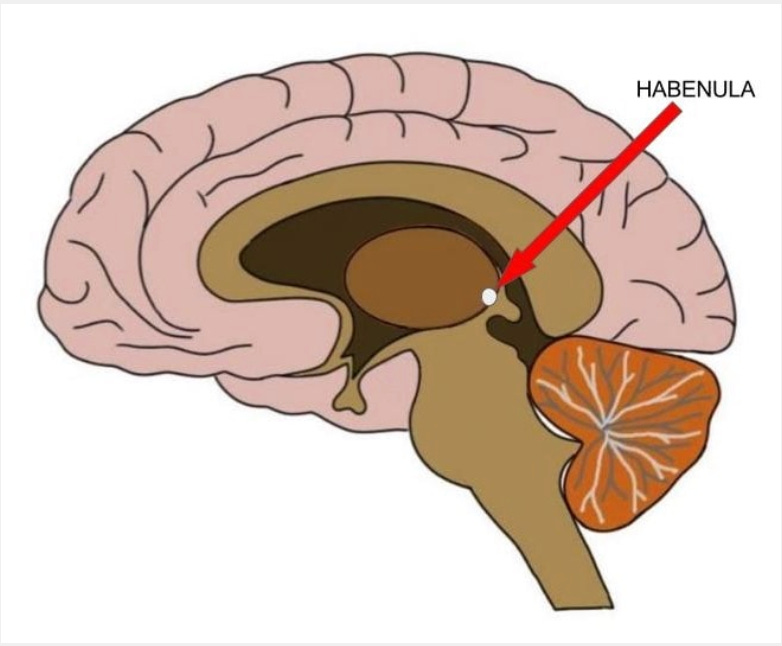
Here’s our little habenula!1 that’s trying hard to help us, but making things more difficult.
A brief reminder:
Knowing that our brain is running an anti‑reward system in the background can help us understand why ordinary tasks can feel like wading through wet concrete. It is not that love or commitment has faded; it may be because our nervous system has been taught by repetition to brace for failure.2 The habenula is trying to protect us from more hurt and pain.
We can try small experiments and practices as a salve for that circuit. Stimulate our brains with positive reinforcement learning.
This is not about adding anything onto our caregiving plate. It’s about looking at the plate differently, and reframing how we treat ourselves and our approach to caregiving.
When you’re trying hard to push and motivate yourself but find yourself slowing down with fear or other negative feelings, your habenula is probably putting the brakes on!
Hopefully, trying out some small, iterative experiments will help release the habenula brake.
Kyra Bobinet’s brainstorming tool ‘ITERATES’
In her book, Bobinet3 describes how she discovered the ‘MacGyvers’:
“I was keenly curious about people who seemed to transcend all the barriers that public health has identified: social determinants of health, health disparities, food deserts, single parenting, senior caregiving, socioeconomic challenges. What was it that set them apart? What were they doing differently than so many others?
Around the same time, in my teaching at Stanford School of Medicine, my colleague Dr. Larry Chu had put together a panel of expert patients who had revealed an incredible ability to manage their afflictions, be it cancer, severe arthritis, IBD, or heart disease. Noticing a similar trajectory among the retail associates, I began studying, with a blank slate, what they had in common.”
In short, she found out these ‘MacGyvers’
Instead of setting rigid goals, they experiment—asking "Let's see if this works" rather than treating actions as pass-or-fail tests.
They practise new behaviours, such as learning a skill and observing what happened without harsh judgment.
When something doesn't work, they iterate: tweaking and adapting their approach in small ways until they find what fits.
Bobinet and her team called this MacGyverism: the Iterative Mindset—people are iterative—continuously improving—in their approach, instead of performative.
This aligns with what I know about
Lean processes that are used in research, development, and production, which focus on continuous improvement; seeking dynamic gains rather than static efficiencies.
Professor Carol Dweck's research about the power of a "growth mindset,": contrary to a "fixed mindset," which assumes that abilities are static, a growth mindset fosters resilience, openness to new experiences, and a willingness to take risks. It comes from shifting perceptions of personal traits. People with a growth mindset are less interested in appraising supposedly unchanging characteristics—IQ, musical aptitude, physical gifts, etc.—and more interested in how skills can be cultivated and improved through practice.
This will all sound very familiar to caregivers, especially those of us who’ve been caring for a long time. We build a practice of agility, adapting, trying to find solutions with what we have to hand, using the energy and time available.
Instead of defining specific instructions and a cookie-cutter answer, Bobinet suggests this brainstorming tool, a heuristic4, to generate ideas: “ITERATES.”
Whether you’re a practised ‘MacGyver’ caregiver or not, these prompts can stimulate your ideas about how to approach something differently.
I – Inspiration: Motivational mantras / reframes that protect from failure
T – Time: Frequency, duration, repetition, timing, habit stacking
E – Environment: Making it easier to do the positive thing, harder to do the negative thing
R – Reduce: Difficulty, intensity, complexity, cost, peer pressure, temptation
A – Add: Abundance, ease, variety, social support
T – Togetherness: Do with others, join groups, invite peers
E – Environment: Making it easier to do the positive thing, harder to do the negative thing
S – Swaps: Healthier substitutions, similar sensations/emotions, feasible changes
You can read more details about these in her book: Kyra Bobinet’s book, “Unstoppable Brain: The New Neuroscience that Frees Us from Failure, Eases Our Stress, and Creates Lasting Change” (Published 19 March 2024)
Working With Your Habenula as a Caregiver
After watching the TED Talk and reading more about the habenula, I used Kyra Bobinet’s brainstorming tool ‘ITERATES’ to create 30 ideas that we can use to soften the habenula’s impact.
Simple ideas to stimulate a little curiosity and provide you with a starting point.
Remember, we want to iterate, not for perfection, but for small gains and wins, build our psychological safety, and practice curiosity.
Name one tiny win each day. Before bed, write or say one thing that went slightly better than expected, however small. Put a ‘One tiny win’ as a post-it reminder by your bed or a notification on your phone.
Anchor yourself with one daily question. For example: “What eased something, even 1%, today?” Answering this in a notebook or on your phone nudges your brain to search for micro-improvements, not just what went wrong. You now have a list of ‘ease-ers’
Shrink the time frame. Ask, “What’s one small thing I can do in the next 5 minutes to ease things?” rather than trying to fix the whole day, week, or future.
Practice “better than nothing” thinking. When you only manage half of what you hoped, deliberately label it as “better than nothing” instead of “not good enough.” This helps the habenula log partial success rather than total failure. For example, you cleaned the shower, not the whole bathroom.
Use ‘encouragement reminders’ when your motivation is low. Set up a ping notification of ‘You’re doing your best, you’re not alone’
Mark completions out loud. After a hard task, quietly say, “That was difficult, and I did it.” Your brain needs to register success, not only strain.
Keep a ‘help tips’ menu. Create a list of small things that help a little each time: a particular song, a warm washcloth, a favourite snack, a short walk, a silly TV clip. It’s the act of noticing the ‘good things’ in the moment that helps rewire the habenula. Its negative feedback loop requires only a tiny negative feed to switch off motivation. Use the tips list when you’re stuck. Choose from the menu rather than starting from scratch.
Use visual cues for progress. Keep a small jar and drop in a bead, paperclip, or folded note each time you get through a tough routine. Mix it up into a colourful artwork! Watching it fill up counterbalances the brain’s tendency to notice only what went wrong.
Turn “failure” into information. Instead of “I failed,” try this phrase: “That approach didn’t work in this situation. Now I know more than I did yesterday.”
Say, “This is hard and I’m learning.” When something goes badly, pair the difficulty with learning: “Today was brutal, and I learned that mornings are better for trying that routine.” This tells the habenula that the pain is buying information, not just defeat.
Call new ideas “experiments “I’m trying an experiment with Dad’s evening routine”, sounds gentler than “I’ve got to get this right.” Experiments are allowed to be messy, iterative and progressive!
Gently challenge all-or-nothing thoughts. When “I can’t fix this” or “I can’t prevent this” shows up, answer with, “I can’t fix everything, but I can ease something today.”
Use “today, not forever” language When your mind jumps to “It will always be like this,” gently answer, “This is how it is today.” Anchoring in today reduces the sense of endless struggle or projecting into future scenarios. This is a big one because our brains are natural prediction and time travel machines. I use my five senses to re-anchor myself into the here and now moment.
Use “for now” decisions. When you feel trapped between bad options, say, “This is the best choice I can make based on what I know for now.” This stops your brain from treating one decision as a permanent, all-or-nothing test.
Make ‘Should’ a swear word. Remove expectations to focus on what’s possible in your set of circumstances, not try to impose a socially conditioned set of judgments.
Use kinder language for hard moments. Swap “disaster” or “I messed everything up” or “I’m useless” for “That was a really hard moment” or “I know I’m trying and doing my best” or “That didn’t go how I hoped.” (and try to ignore thoughts about what ‘so and so’ would say/do differently. You’re the one here doing your best!)
Protect a few tiny zones of control. Maybe it is how you arrange the pill box, the mug you use in the morning, or the playlist you play while changing sheets. These anchors remind your brain that not everything is out of control.
Name what is outside your control. Write down what you truly cannot change (disease progression, waiting times, other people’s reactions). Seeing it on paper can reduce self-blame and stop the habenula from treating every bad outcome as your personal failure.
Decide where ‘good enough’ is truly enough. Pick areas where you will not aim for perfection (dusting, perfectly folded laundry). Fewer impossible standards mean fewer chances to label the day a “failure.” It’s also a way to set boundaries.
Practice compassionate self-talk. When you feel you are “not coping,” try: “Anyone in my situation would find this hard. I am doing the best I can with what I have today.”
Practice “one kinder thought.” When you catch a harsh self-judgment (“I’m useless at this”), gently add, “AND…” followed by something truer and kinder (“…I’m still here, showing up every day”). This softens the impact without forcing fake positivity.
Schedule one small pleasure most days: A favourite biscuit with tea, 10 minutes journaling, a short walk, a warm shower with music. Predictable small joys give the brain reasons to keep showing up.
Name the pattern, not your character. Shift from “I always mess this up” to “This is a tricky time of day for both of us.” It moves the blame from your identity to a pattern you can work with. Remember to distinguish between shame and guilt.5
Start a ‘self-congratulations list’. Your ‘gold stars’: your loved one’s relaxed expression, when you avoided snapping and used a softer tone of voice, a “thank you,” a crisis avoided, hand-holding or other precious loving moments. Re-read them on the days your brain insists, “None of this makes any difference.”
Make a sensory memory-snapshot to recall later. Take a few minutes to use each of your five senses in turn, to capture the moment and label the memory “This is what good looks like when…” for sensory recall later.
Share the story with someone who “gets it.” Telling another carer, “My brain keeps saying ‘I’m failing, I’m not doing anything well’” Hearing, “I get it,” can interrupt the isolation that magnifies the habenula’s voice. Being witnessed turns private “failure” into a shared human reality.
Countdowns for stuck moments. When frozen, count down quietly from 5, then take only the first step (stand up, pick up the phone, open the form). Micro-initiations give your brain a small “I moved” win.
Use music as a state shifter. Build a short playlist for “getting going,” another for “winding down,” and one for “crying safely.” Music can guide your nervous system from shutdown towards movement or release. This rewires from ‘stuck or failed’ to ‘I can handle the tough times.’ This is one I use all the time! Here are some playlists to get you started
Give your inner critic a nickname. When the voice saying “You idiot?” pipes up, address it as a character. Naming it creates a bit of distance and makes its verdicts feel less like facts. “Mr Inspector…thank you, but the reality is I’m tired and only human…let’s stick to small wins please”
Connect your efforts to your values, not outcomes
When results are uncertain, remind yourself of your values. This shifts you away from a performance scorecard, tickboxing “Did I fix it?” to “Did I act in the way that matters to me?”, which the habenula finds less punishing. This is one I’ll be writing more about with resources and tips.
Discussion and experimentation
Save this article so you can pick and choose from this menu of ideas anytime.
Is there one idea that resonates the most with you?
Try an idea and see how you feel. It doesn’t have to be exact or perfect. Personalise it to your preferences, personality and routine.
Let me know in the comments how you get on with your small experiment, or write an article and share it below.
I’ll be sharing more ideas in our Community Hub on Saturday, 24th January.
Take comfort and remember…
You are not weak when motivation fades. Often, it could be this tiny brain system trying to protect you from more hurt.
When your angst or fear increases, your brain has likely activated your habenula in anticipation of a negative experience. Drawing on some of these ideas, we can cultivate positive intentions and redefine success.
Watch out for the next article in this Curious to Thrive series.
Please remember to ‘❤️’ LIKE the article to guide others to these resources
Consider a paid subscription, use this discount to join the Community Hub, or contact me for free access, no questions asked. Direct message me on Substack or email: vlchin@carermentor.com
If you wish to cancel your subscription at any time, please read this information.
Namboodiri, V. M. K., Rodriguez-Romaguera, J., & Stuber, G. D. (2016). The habenula. Current Biology, 26(19), R873-R877. https://doi.org/10.1016/j.cub.2016.08.051
Hikosaka, O. (2010). The habenula: From stress evasion to value-based decision-making. Nature Reviews Neuroscience, 11(7), 503-513. https://doi.org/10.1038/nrn2866
Kyra Bobinet, Unstoppable Brain: The New Neuroscience that Frees Us from Failure, Eases Our Stress, and Creates Lasting Change (p. 154). (Function)
‘Heuristic’ is a method of learning or solving problems by trial-and-error of our own experience. As a heuristic, it is a good test to ask the question: “what might I do in this situation?” In simple terms, a heuristic is a mental shortcut or “rule of thumb” that helps you solve problems and make decisions quickly. It’s important to note that heuristics are open to cognitive biases, e.g. overestimation or underestimation of competence.
Brené Brown distinguishes shame as “I am bad” (focused on self, leading to paralysis/hiding) from guilt as “I did something bad” (focused on behaviour, motivating change and amends). Guilt is adaptive, signalling a mismatch with values, while shame is destructive, making you feel unworthy of love and belonging, often linked to addiction, depression, and violence. Here’s Brené’s TEDTalk “We need to talk about shame.” (July 31, 2021)
This was a fascinating read. I discovered that I’ve been able to keep my sanity as a caregiver for so long, due in part to practicing many of these methods.
Thank you for sharing more on the habenula. I just read another post, in a totally different context, talking about approaching goals/projects as experiments. She referenced the book "Tiny Experiments" by Anne-Laure Le Cunff. I haven't read it, but I love how this is all coming forward at the same time for me.
Viewing life as a series of experiments, where we learn from uncertainty, and embrace the wisdom it brings. It reminds me of the unalome symbol or a meditation labyrinth. Life isn't a straight path and a seeming failure may just be a piece of information to help you with your next experiment.
I'm looking forward to trying your tips and softening the habenula's impact. I'm keeping in mind, that it is trying to help, but it can only work with what I give it.
I currently do list 3 very specific things I'm grateful for and why, before going to sleep. I feel it puts me in a good headspace for rest.
I also plan to try your "Mark completions out loud" tip. It is so easy to think I did nothing worthwhile during a day or to diminish what it took for me to do something.