
"Meet Your Habenula: Your Motivation 'Kill Switch'. The Tiny Brain Circuit With a Big Impact."
Curious to Thrive #1 Translating questions into ideas to help caregivers.

Hello, Dear Reader! A warm welcome to the new Carer Mentor subscribers! Thank you for taking the time and energy to be here. I’m Victoria. You can read why I’m publishing Carer Mentor here: Who Started Carer Mentor and Why?
The Background Premise to this article.
I’ve been feeling my way through several questions and reflections. I’ll be sharing these in this new Carer Mentor series of articles, ”Curious to Thrive.”
One question I shared as part of Day 1 of The Isolation Journals 30-day New Year’s Project (Thank you, Suleika Jaouad, Carmen Radley and Holly Huitt):
“How do we live with uncertainty, angst and fear but not be caged by it when…..”
The ‘We’ is a vital keyword because for caregivers it’s not only about figuring out how to navigate our own emotions, but about supporting, coaching, considering, …., our loved ones’ feelings, needs, and wishes.
The ‘when’ is important because it’s not only about those obvious times when there’s a health issue, accident or emergency. It’s also when we (the caregiver alone or with our care recipient) have to decide to do something beyond the everyday norm or care routine. How far does the elasticity of our calm stretch from our comfort zone, or from our home environment? How do we assimilate the tension of making the decision as the caregiver?
And, of course, the question contains elements of personal identity and values. Yep, just the everyday existential stuff that can start to impede your brain function at the end of the year, and leads you to justify the extra mince pie or glass of wine to stop the swirl!
In the quest for answers, the science researcher in me discovered the habenula. Several things clicked into place. It’s not a complete eureka answer (I think we all know there’s no such thing.) It’s more evidence-based neuroscience for consideration.
The evidence points to why our inner critic gets louder with fear, dread, and angst, and why we need to practice being adaptive, iterative and agile to stay motivated, especially as a caregiver
Say hello to your little habenula!1
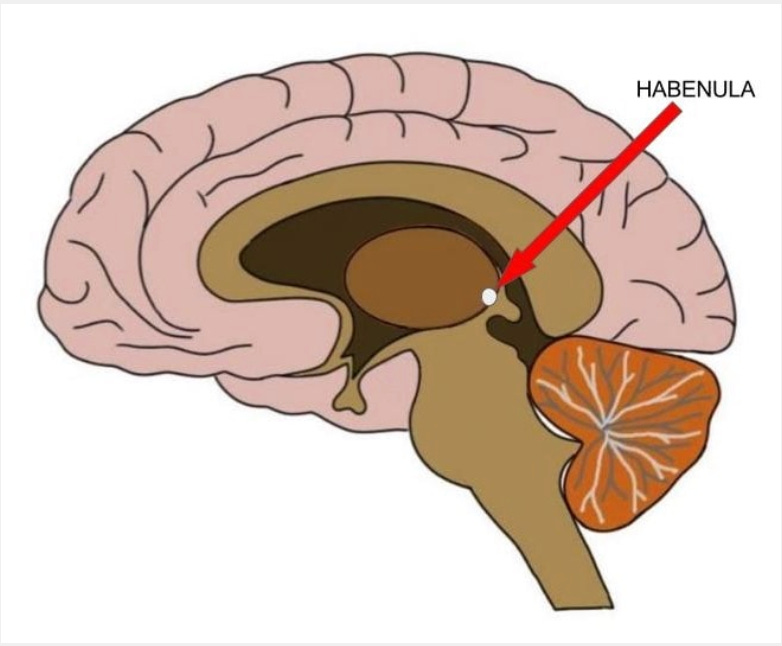
Meet Your Habenula: Your Motivation ‘Kill Switch’. The Tiny Brain Circuit With a Big Impact.
An introduction to your habenula.
The habenula rarely gets a mention in the January self‑improvement season, but it quietly runs the show when resolutions start to wobble.2
The habenula3 is an evolutionarily ancient cluster of neurons in the epithalamus region of the brain. It’s a tiny structure that acts like an early‑warning system for disappointment, switching down motivation when it predicts more pain than reward.
Someone going to the gym might feel this as a sharp dip in drive after a few missed sessions or slower‑than‑hoped progress: the habenula “notes” the gap between effort and visible results and quietly suggests, “Why bother?” So, the fitness resolution wobbles, and people stop going to the gym or the new diet get’s dropped.
For Carers, realising that our brain is running an anti‑reward system in the background can help us understand why ordinary tasks can feel like wading through wet concrete. It is not that love or commitment has faded; it may be because our nervous system has been taught by repetition to brace for failure. Our fear of failure can escalate. Our self-compassion can wane in the shadow of self-judgment.
Over time, the ‘dread factor’ can feel heavier. A problem can seem bigger, or we may feel we need much more energy to address it, compared to the early days of caregiving. Does that ring true for you?
Our little ‘motivation kill switch’ is learning from every crisis, issue, and emergency, as well as our frustrations and self-judgements. The habenula is trying to protect us from more hurt and pain; trying to stop us from repeating what doesn’t feel good.
By learning more about the habenula, we can adopt more intentional practices to encourage ourselves and reframe failure. We can begin treating our small wins and moments of “good enough care” as a salve for that circuit. We can create reminders that not every effort ends in hurt and that there are still reasons for our brains to let us keep showing up.
Learning and doing
By the end of this article, you’ll be familiar with the habenula, its functions, and Kyra Bobinet's work.
In the next article, I’m translating these insights into actions by sharing 30 examples: realistic, simple ways that we can work with, not against, our brain’s motivation system to keep going AND feel more fulfilled.
When you’re trying hard to push and motivate yourself but find yourself slowing down with fear or other negative feelings, your habenula is probably putting the brakes on!
Hopefully, trying out some small, iterative experiments will release the habenula brake.
The Secret to an Unstoppable Brain by Kyra Bobinet
June 23, 2025 TEDxSantaCruz. The TED Talk that triggered me to research more about the habenula
Kyra Bobinet’s book, “Unstoppable Brain: The New Neuroscience that Frees Us from Failure, Eases Our Stress, and Creates Lasting Change” (Published 19 March 2024)
What is the habenula and why does it matter?
The habenula is a tiny but influential brain structure that is central to the brain’s “anti‑reward” system.
It learns from disappointment and can shut down effort when it predicts more pain than reward.
It helps the brain monitor outcomes, especially when things go worse than expected, and it strongly shapes motivation, learning, and persistence.
The core functions of the habenula
The primary function of the habenula is to signal when a predicted/expected reward fails to arrive, or when a negative outcome occurs. It essentially serves as the brain’s “anti-reward” system, detecting failure.
It’s a negative feedback loop: when something goes wrong, or an expected positive result fails to materialise, the habenula becomes highly active.
Dopamine Regulation: the habenula communicates with the brain's main reward centres, primarily by inhibiting the release of dopamine4. This reduction in dopamine signals that the current action or situation is "bad" and needs to stop or be avoided in the future
A Motivation “kill switch”. Since the habenula can reduce activity in reward pathways, an overactive habenula is described as a “motivation kill switch”. It’s linked to giving up, procrastination, and loss of drive.
A Habit and behaviour change. The habenula tracks patterns of repeated failure or negative outcomes. If it “learns” that an action leads to disappointment, it pushes you away from trying again, which can block the formation of new habits or change.
Emotional tone and mood: Chronic over activation of the habenula is associated with low mood, pessimism, and depressive symptoms, because the brain becomes biased towards expecting bad outcomes.
Habenula Research continues in the areas of neuropsychiatric disorders, depression, addiction, resilience.5
Kyra Bobinet has founded a company “Fresh Tri”.
Find out more about her company and its mission here
This description of the habenula’s survival and success modes, as described on the Fresh Tri website will be very familiar to caregivers
Survival Mode vs. Success Mode
When the habenula fires too frequently, it traps us in a state of survival mode, characterized by fear, urgency, and stress. In this mode, we might appear productive, but our brains are operating under pressure, not purpose.
Survival signals include:
Fear of failure (“If I mess up, it’s over”)
Constant pressure (“I have to prove myself”)
Exhaustion or burnout (“I can’t keep this up”)
While survival mode can create short bursts of performance, it comes at a cost: burnout, anxiety, and disconnection.
By contrast, success mode is rooted in curiosity, safety, and engagement. When we feel supported and free to experiment, dopamine stays active, and the habenula stays calm. That’s when learning, creativity, and motivation thrive.
The difference between these modes is emotional safety. Feeling safe gives the brain permission to keep trying.
Emotional safety, is not something we easily feel as caregivers. Figuring ways to promote the feelings of emotional safety is essential.
Here are three practical ways to stay out of “habenula shutdown”:
1. Practice Iteration Over Perfection
Instead of expecting instant results, view each attempt as a test. Ask yourself: What did I learn? What might I tweak next time? This mindset reframes setbacks as data, not failure, keeping dopamine flowing and motivation alive.
2. Create Psychological Safety
Your brain needs to feel safe to try new things. Celebrate progress, no matter how small. Leaders, coaches, and teams who promote safety over pressure create environments where people are more resilient, creative, and engaged.
3. Follow Curiosity
Joy and curiosity are powerful antidotes to fear. When you approach habits, work, or goals with genuine interest rather than obligation, your brain stays motivated for longer.
I think it’s important to note that for some caregivers, they may be in a constant hypervigilant state, when it’s impossible to think about anything except getting through each day and surviving whatever emergency or issue that’s happened. They may not have the brain space, energy or time to consider changing anything. There are times when you can’t take more into your day or brain!
I’m hoping that by sharing this information we can raise awareness and start cultivating the practices we need for when those times emerge.
For those of us who do have a little capacity to consider trying new practices now:
How can we put these learnings into action, more intentionally?
How can caregivers shift from survival mode to success mode using this information?
In the next Curious to Thrive article I’ll be sharing a menu of ideas for you to try as small experiments.
I’m not an habenula expert. I just know variations of things I’ve tried while caregiving to keep myself motivated. I’m sure you’ve ideas. Let’s share them to help each other.
Circling back to my original question
“How do we live with uncertainty, angst and fear but not be caged by it when…..”
There won’t be a complete or satisfactory answer, or a panacea. I don’t expect one.
Curiously researching the habenula has given me some interesting context and reasons for why the angst and fear gets louder. We love to think we can control and manage everything but we can’t, especially while caregiving.
To avoid being caged by the uncertainty and fear, I need to keep finding new ways to reframe and rethink it…more curious noodling for sure!
I’m sure many carers will resonate with the need for lateral thinking, a can-do attitude and agility…it’s just a little tiring to think of this at the start of another new calendar year…Ahhh that’s the habenula talking again! 💡
Remember…
When you’re in the swirl of negative thoughts. judging yourself or what you do as failing— remember, you are not weak when your motivation fades. Often, it’s this tiny brain system trying to protect you from more hurt.
We’re not only experiencing the pain of watching those we love suffer, our brain’s in a survival not success mode, and it’s continuously learning about the hurt and “failure.”
When we start to apply a curious growth mindset6 to events and outcomes instead of using performative measures, and definitives like “failure” we can work with our habenula.
Look out for the next article in the Carer Mentor “Curious to Thrive” series that explores practical ideas you can put into practice, Kyra Bobinet’s brainstorming tool and more about the growth mindset.
Discussion
Have you heard about the habenula before?
What’s your key takeaway from this information?
Does this resonate?
I’ll look forward to hearing your thoughts.
Let me know if you want more information and links. I’m happy to share what I’ve found so that we can build more awareness, articles and thoughts on this topic.
THE NEXT ARTICLE

I’m interested in hearing thoughts from some doctor/psychologist/therapist friends:
Tanmeet Sethi, MD - I think you’ll be interested in Kyra Bobinet’s book and her thoughts on the use of psychedelics.
Amber Groomes,Ph.D. (she/her), Dr Vicki Connop, Johanna Sartori - given the location and interaction with the ‘reward system’ the habenula is implicated in depression and addiction. E.g. “Evolution of circuits regulating pleasure and happiness with the habenula in control” Anton J. M. Loonen and Svetlana A. Ivanova
Mary Braun Bates, MD, Dr Rachel Molloy - have you come across this research?
Please Remember to ‘❤️’ LIKE the article to guide others to these resources
Namboodiri, V. M. K., Rodriguez-Romaguera, J., & Stuber, G. D. (2016). The habenula. Current Biology, 26(19), R873-R877. https://doi.org/10.1016/j.cub.2016.08.051
The habenula was featured in an article in Oprah Daily By Jessie Van Amburg, March 6 2025 “This Tiny Area of the Brain Is Killing Your Motivation. Here’s how to hack it.” This is where I found the term ‘Kill Switch’’
Ables JL, Park K, Ibañez-Tallon I. Understanding the habenula: A major node in circuits regulating emotion and motivation. Pharmacol Res. 2023 Apr;190:106734. doi: 10.1016/j.phrs.2023.106734. Epub 2023 Mar 16. PMID: 36933754; PMCID: PMC11081310.
Over the last decade, the understanding of the habenula has rapidly advanced from being an understudied brain area with the Latin name ‘habena” meaning “little rein”, to being considered a “major rein” in the control of key monoaminergic brain centers. This ancient brain structure is a strategic node in the information flow from fronto-limbic brain areas to brainstem nuclei. As such, it plays a crucial role in regulating emotional, motivational, and cognitive behaviors and has been implicated in several neuropsychiatric disorders, including depression and addiction. - from the Abstract
Dopamine is a neurotransmitter associated with pleasure, motivation, and reward
The Habenula and Its Role in Neuropsychiatric Disorders (Frontiers, 24 May 2022) Flavia Venetucci Gouveia, Phillip Michael Baker, Manuel Mameli and Jurgen Germann:
“The habenula is a small epithalamic structure that is critically involved in the control of major neurotransmitters, such as the cholinergic and monoaminergic (i.e. dopamine, serotonin, noradrenaline/norepinephrine) systems. The role of the habenula in depression and addiction is being investigated intensively. However, the habenula is involved in a wide range of behaviors (e.g. social behavior, circadian rhythms, eating behavior, reward processing, prediction of behavioral output, and subsequent correction) implicated in the neurobiology of a number of psychiatric disorders and neuropsychiatric symptoms.”
Who knew about the tiny but powerful habenula?--I certainly did not! As someone who has struggled with Depression and Anxiety most of my adult life, I'm so glad to learn about the habenula's ability to keep track of mood and influence reactions and results... and not in a particularly good/constructive way. I've tried using positive self-talk for many years, but I think adding a little curiosity and thoughts about positive outcomes to the reframing might really help. Thanks so much for this fascinating article, and I so look forward to your next article about our relationships with our own habenulas!
I had never heard of the habenula—but my goodness this came at a good moment for me! I’m feeling shot down over a recent (as in last night) disappointment, and was thinking, “I give up.” Now, I’m asking myself, “What have I learned?” Thank you, Victoria!!