
“The Long Road Home for a Different Kind of Future” By Haley Haddow
This was a choosing, and ultimately a becoming.


Hello, Dear Reader! Welcome to our new Carer Mentor community members!
I’m Victoria. I created Carer Mentor to offer heartfelt empathy for Caregivers. It’s a hub of practical tools, resources, and insights. A community support network for all of us human-ing hard. ❤️
You can read about why I started Carer Mentor: Empathy and Inspiration here. I recommend using the quick-start navigation guide to explore the website.
Every caregiver’s experience is given space to breathe and gently connect. Empathy and inspiration unfold, offered and shared. No one stands alone here.
Letters from a Caregiver.
“Letters from a Caregiver” is a weekly article where a caregiver offers wisdom, compassion, and hope to their younger self. No one knows us as well as we know ourselves, and even then, we may second-guess ourselves. The choices, challenges and tragedies we’ve faced have forged us in more ways than anyone can understand; in ways we’re still trying to decipher!
There are two previous seasons of Twenty-Two Letters.
This Spring Season so far
“Misunderstood, and everyone has an opinion,” By Victoria
“What It Takes To Embrace the Life He Has “ By Chris B. Writes
Today’s letter is by Haley Haddow
I met Haley around November, 2025 and was drawn to her writing. She manages to capture the deeper essence of a moment, the flow of actions, and shifting emotions. Perhaps the patience and creativity she used as an award-winning glass artist have allowed her to bottle her magic onto the page.
It’s why I love the words she’s used in her own author’s bio: “she shares her own and others’ stories to illuminate what so often goes unseen.”
While our rollercoasters are different, I feel a deep resonance with the last paragraphs of her letter. Some decisions are made, not because of choosing between options, but because of a “fierce clarity.”
Thank you, Haley, for sharing your ‘path of becoming’.
I recommend reading these other articles by Haley:
“My Fairy Godmother Called Today. So here I am, and here I start”
“The Other Side of Caring “You failed him. And you’ve failed us.””
And one of my favourites is “The Sunflower Lanyard Max had been seen. He had been capable. He had been useful and ...just simply included.” because she’s shared such a great moment, I guffawed, and like Haley, I had brain-whiplash, mentally checking “what just happened!?!”
Author’s Bio: In her early twenties, Haley followed her passion for adventure and travel by living as an expat in the United Arab Emirates. Later, returning married and expecting her first child, she established a glass art studio. She relocated to the UK when her second child was diagnosed with autism and is now his full-time carer, placing her career as a glass artist on hold. She has come to understand that while people often see strength in caregivers, they rarely see the interior world. Through “Thousands of Us”, she shares her own and others’ stories to illuminate what so often goes unseen.
“The Long Road Home for a Different Kind of Future”
Dear Haley of January 2013
Its thirteen years in the future, and I want you to know.
You did it. All by yourself.
And despite everything, and there’s been a lot.. you were right.
Your intuition spoke and you listened. It was the right choice. It was the only choice.
Thirteen years ago, your seven-year-old baby girl was sitting in the backseat of your cream SUV, the engine humming softly, idling under the carport. Waiting.
You remember it like it was yesterday as it resides quietly in the folds of your memories.
Her little face was so pale, eyes wide with confusion. Despite your best efforts to explain, an aura of bewilderment clung to her. Too young to fully absorb events, but old enough to know the only life she’d ever lived was over. Her childhood of playing in perfectly manicured hotel gardens and poolside parties was no more.
You knew her heart was broken leaving her best friend, Jaimie, only three days younger. She broke yours telling you, “she’s my bestest best friend, Mummy.”
And Max, sat next to his sister, his huge brown eyes gazing innocently out of the window, unaware of his disability and its impact on the family.
You think of the preceding year, the truths that arrived quietly, settling in your bones with a quiet knowing. They sat beside you at the edge of the bed at 3 am, or while brushing your teeth, until that morning when you looked in the mirror and were finally brave enough to say them out loud:
Something is wrong.
My child needs more. Much more.
The delay in speech, the behaviour, the meltdowns.
You breathed out. You processed. You took control.
Bravely.
And so it began.
There were countless hours lost in research online, sitting at the dining room table in search of a solution to something you barely grasped. Aware you were in uncharted territory, unaware that the journey was less about finding an answer and more about learning to navigate the unknown.
Then, there was a breakthrough.
A specialist center in the city.
You signed up to a six-month waiting list. When you got the call, you drove the three-hour round trip alone, across a stretch of endless thin grey ribbon of road through the desert, your eyes fixed ahead on the broken white lines. Occasionally you’d glance in the rearview mirror at your little man, so cute, so vulnerable, sitting in his car seat, his innocent face perfectly framed.
Week after week after week.
Your life became awash with reams of paperwork, a battery of questions on developmental history and behavioural observation tests.
And then.
You did not expect the word that followed to rearrange the architecture of your life.
Autism.
It did not arrive gently. It did not arrive as a whisper. It arrived in full detail within a forty-page final diagnosis report. Clinical, bound, definitive, and yet somehow still unable to capture the little boy you know, who is beautiful, sunshine, cheekiness and noise.
New terminology is introduced to you that in future will become your second language:
Challenging behaviour, significant problems with social interactions and communication, speech, language and occupational therapy.
You met with a friend over coffee. She looked at you and said, “I think you have to go home.”
The weight of her words echoed a truth you had already known.
You nodded with a quiet calm, and just like that, the decision was sealed.
You had to leave. There was no other way.
Three suitcases in the boot. Two children in the back. That was it. An expat life of eight years, three months, two days reduced to weight limits and zipped compartments.
In the distance, the prayer call rose across the morning air. After months of organizing, planning, justifying, and explaining, you finally let yourself feel it..the first pang of sadness. Yes, this is real.
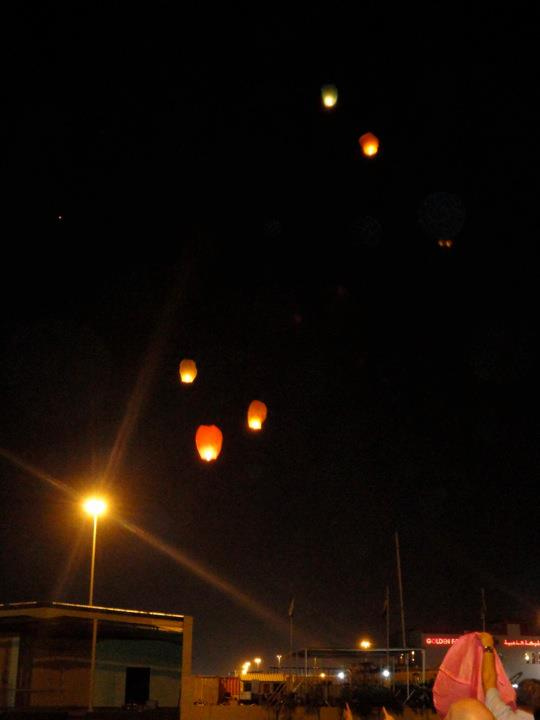
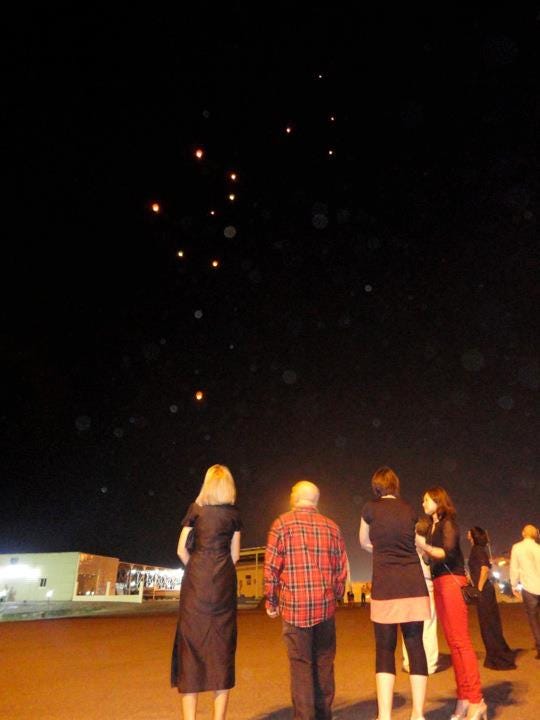
You remember the leaving party clearly. Outside on the marina, everyone had lit Chinese lanterns, each making a wish for your son, holding light in their hands for his path, for your strength, for the unknown future. They fluttered and climbed into the darkest blue night sky above the Indian Ocean until they became small little beacons of light.. of hope.
What a journey.
But listen carefully, because you need to know what you couldn’t know then.
Do not allow doubt. Sadness, of course.. but there is a difference. Learn that difference. It will save you later.
Back home in the UK, the first months will be brutal. Like really.
You’ve done your research, gathered your paperwork, and been warned by friends to be battle-ready.
You hit the ground running…hard.
It will be a brutal reckoning. You have returned to a special education needs system that is overwhelmed, underfunded and understaffed. 4,000 miles away in the UAE your son was treated like an anomaly, a quirk, a freak, a deviation from the “norm”. Back home he is one of many.. the enormity of the irony will not escape you.
But listen, you are not weak for the times you cry in the shower, at the traffic lights, in the park, or at the kitchen sink. You are not failing when you are tired of being strong. And I know you are so tired.
After four months, you secure a school placement, a hard-won victory. You shake your head in disbelief when told how fast that is. They did not see the sleepless nights, the letters, the emails, the calls, the tenacity to never give up, even through hell. It feels less like a process and more like a siege. When you come up for air, you will be exhausted… and this is just the beginning.
But.
Kindness will find you, and not always where you expect it. You will learn that systems are frustrating, bureaucratic, and flawed…. but people, people can be extraordinary.
And you.
Yes, you will make mistakes. Some you will replay at night like courtroom evidence against yourself. Forgive yourself faster. Remember that you are the woman who stayed in the arena. No kidding Brene!
You will learn to advocate like you breathe and discover in yourself a relentless mode of resilience. You have already done so much with so little that one day you will realise you can do anything with nothing. Let that sink in.
You are not behind. You move forward every day even if you cannot see it. Have faith.
You cannot re-write your story, but you can honour it and tell it. One day someone else will stand where you are standing, and they will need proof that choosing the hard road, is still choosing well. The cost will be high. Higher than you could have ever imagined… but it is worth it.
In the early years, there will be days you grieve the life you had, the sacrifices you’ve had to make. Let yourself. There’s no timeline on your grief, you don’t have to be over this loss by now, or indeed the ones that follow.
Leaving was the right decision because it aligned with the truth and you could never have lived with yourself if you had stayed. You chose your son’s needs over your comfort, your plans, your imagined future. That is not failure. That is fierce clarity.
This was not just a move. This was a choosing, and ultimately a becoming. You are on the path to a version of yourself that is stronger and braver than you could ever realise. I am proud of what you have, and will continue to walk through.
Speak to yourself kindly. Be gentler with yourself than you think you deserve.
Keep going.
There are many more challenges ahead, and some you think…. might break you.
I am living proof that you will… and they didn’t.
Three Rapid Questions
Describe one thing you do to move through fear or uncertainty during caregiving.
When fear rises, I pause and take a breath. I break the immediate problem into small, manageable steps and focus only on what I can control. I remind myself how far I’ve already come, how many hurdles once felt insurmountable but weren’t. I try to actively anchor myself in the “what is” rather than spiralling into the “what if.” The present may be hard, but it is almost always more survivable than the imagined future, although it is hard to practice this “in the moment”.
Thinking of someone you admire/respect, name three of their standout qualities/characteristics
A former colleague comes to mind, someone who has been steadfast in their support of me over several years.
First, loyalty. Consistent and simply remaining “present.”
Second, empathy. Their own life looks very different from mine, yet they have always made space to understand my reality.
And third, generosity of spirit. They have shown interest in my wellbeing and my children’s on a level far beyond my expectation, exceeding familial bonds. My gratitude for their presence is immense. They have taught me that support does not have to be loud to be life-changing.
What’s one quote/movie/book that’s inspired you?
Nothing on the outside is more powerful than you.
Prompt for discussion:
Your child is now a young adult, vulnerable, requiring a high level of support, and likely to do so for the rest of their life. Statistically, it is highly likely they will outlive you. It is a truth that no one will ever care in quite the way you do, yet you must prepare to loosen your grip responsibly, lovingly, with a view to a long-term solution.
How do you navigate the fear of supported government care, the unpredictability, the lottery of “good” versus merely adequate (at best) or negligent, fuelled by horror stories in the news, while also recognising that you are human, ageing, and entitled to a life beyond constant caregiving?
How do you sit with that knowledge without being consumed by it?
I would love to hear how others are holding (handling?) the paradox… between protection and preparation.
Please like ‘❤️’ the article to guide others here.
 | A guest post by
|
So beautiful! As a mother of two boys with exceptionalities, I feel these words in my bones. I recently finished a manuscript of my book and ended it with a letter to my younger self. Such healing work!
Such beautiful writing from Haley. ❤️