
'The Gift Of Self-Compassion For The Caregiver', by Amy Brown
The Ninth 'Letter from a Caregiver,' Winter Season 2025/26.


Hello, dear Friends! If you’re new to Carer Mentor, you can learn more about me by reading Who Started Carer Mentor and Why?
The ‘Letters from a Caregiver’ Collaboration series continues with this article, the ninth letter of the Winter 2025/26 Season.
Letters from a Caregiver’ is a weekly article where a caregiver offers wisdom, compassion, and hope to their younger self. No one knows us as well as we know ourselves, and even then, we may second-guess ourselves. The choices, challenges and tragedies we’ve faced have forged us in more ways than anyone can understand; in ways we’re still trying to decipher!
Previous letters, this season:
The Winter Season of ‘Letters from a Caregiver.’ Life’s Tapestry: the nuances, choices, and caregiving despite the fear. By Victoria
‘Relearning Hope In A Time Of Darkeness’ By Victoria
‘You Published Your Book! And Now What?’ By Cindy Martindale
‘The Light We Carry’ By Victoria
In early February 2024, when I published ‘Dementia, the Unforgettable Impact on Caregivers,’ I wanted to find a way to share how Dad and I had communicated beyond his health issues and despite the dementia-related disconnects.
Dementia patients may forget words, but I’ve seen and felt how a piece of music can reconnect us. No words are needed.
A discussion thread article started by Sarah Fay on February 16th offered a perfect opportunity to invite others to a collaboration around uplifting music memories
“Why? Dementia patients may forget words, but they don’t forget how something made them feel. Caregivers need uplifting stories; EVERYONE needs to be lifted up by meaningful moments.”
Amy Brown, the author of today’s Letter from a Caregiver, was one of the first contributors to the collaboration article: ‘Music Memory is more powerful than words.’ Empathy and human connection via music can overcome the Dementia Disconnect.
Our love of music comforted us as we cared for our parents, and we share a common goal to support other caregivers, especially those caring for loved ones with dementia.
I’m drawn to Amy’s essays, full of warmth and generosity. She doesn’t shy away from sharing her vulnerability and the painful moments she’s been through.
These days, Amy gently navigates her grief whilst courageously pursuing her thirst for life. I recommend reading about how she relocated from Florida to Barcelona, or how she walked the Camino de Santiago with her daughter in her publication Living in 3D. Amy’s determined to shine!
I feel blessed that we’ve grown a mutual appreciation and kinship, sharing our life experiences. Thank you for writing this letter to your younger self, dear Amy.
Author’s Bio: Author’s Bio: Amy Brown is a daughter, mother, sister, friend who became the full-time at-home caregiver for her mother with dementia just one month after initiating the end of her own 33-year marriage at age 62. In navigating multiple major life transitions all at once, Amy held fast to the idea that her destiny—her story—was still unfolding, and that each of us is in the constant process of becoming, no matter our age. A journalist, ghostwriter, novelist and essayist, Amy writes Living in 3D. A native New Yorker, she is now based in Barcelona.
The gift of self-compassion for the caregiver
Dear sweet Amy,
Close your eyes and picture it. The warmth of the sun on your face. The feel of your mother’s soft, papery hand in yours. You are sitting in the garden of the memory care facility in Venice, Florida and it is your 64th birthday. You open your eyes and see her smile at you. She accepts the bits of chocolate cookie you offer to celebrate your birthday. She closes her eyes and lets the sun warm her lined, 87-year-old face, still beautiful, still the Mommy who cared so well for you and your younger siblings. She is still the wisest woman you have ever known. Even after dementia stole her language, her love of words, the wisdom is in her dancing brown eyes, her wry smile, and the steady feel of her hand on yours.
When you came to her room that morning, it was with a heavy heart. The nurse from hospice had taken you aside to tell you Mom was “transitioning” and explained what that meant. You know the nurse chooses the word carefully, with empathy. It doesn’t have the bluntness of “dying” and you are grateful for that kindness. Mom is refusing food or drink, she tells you. She is getting morphine for her pain, for her comfort. She only wants to sleep.
You felt so afraid as you walked slowly to her room. Not yet, please, you prayed. Not today. You stood next to her bed and put your hand on her shoulder, and said, “Mom, I’m here.” She opened her eyes and a huge smile blossomed on that beloved face. “You’re here,” she said. “Yes,” I said. “It’s my birthday. I’ve brought us a treat. Would you like to go sit out in the sun with me?” She nodded eagerly. She winced as you eased her into the wheelchair. She is so frail now. She has always been petite, but now her legs are like kindling, her shoulder bones sharp under her sweater.
You walk her past the many people you have come to know in these six months Mom has lived here. These other men and women with dementia make you smile and they also break your heart. The elderly woman walking around with one shoe on her foot, asking you if you’ve seen her other shoe. She thinks her daddy has it. You also watch the other caregivers and see yourself in their sadness, struggle and worry. You will never forget the devoted husband of Judy, the joyful woman resident who slowly, painfully, lost her joy to confusion and silence, and finally an inability to recognize her husband. You walk by his car one day as you are leaving the facility and see him, his hands gripping the steering wheel, shoulders shaking with sobs, tears streaming down his face. You got into your car and let yourself cry, too. Necessary tears. Healing tears.
You know Mom rallied for you that day, because it was your birthday. It was the last time she got out of bed. Over the next two days, she continued to refuse food and drink, only a few sips of water. On the third day, you came to her bedside and read to her from her favorite childhood book, The Bobbsey Twins. Her eyes were closed, she seemed agitated, waving a hand in front of her eyes, as if wanting to make something disappear. But her other hand gripped yours tightly. You sensed she was afraid and you didn’t want her to be afraid. The same way her bedtime stories soothed you, you hoped the reading aloud would soothe her. You imagined transporting her to a more comfortable, kinder place, in this particular story, a kitten that keeps little Freddie company in the darkness of the department store where he wandered away and got lost. You know that your mother’s beloved cat, Pablo Picasso, is waiting at the end of that rainbow bridge and you hope she is thinking of him. You start to sing Freda’s favorite song, Kermit’s “The Rainbow Connection.”
It is music that has connected you time and time again, over the years, and especially when dementia took away so much else. On the CD player in her room, you play her other favorites: Frank Sinatra, Tony Bennett, Nina Simone. The night she met your father, they listened to Nina Simone play live in Greenwich Village. When you turn to another beloved song, Jim Croce’s “Time in A Bottle,” it is almost too much to bear. But she is no longer waving her hands. Her breathing has calmed although her eyes remain closed. In these hours together, surrounded by the music, time stands still. It is choreographed comfort for both of you.
“I love you, Mom” you said that day, again and again, leaning in close. “It’s okay to let go. It’s okay.” That afternoon you are joined by your sister and brother-in-law at her bedside. As she gripped your hand and your sister’s, and a kind nurse stroked her hair, she finally let go. She was at last at peace.
But my dear, your peace has proved elusive. You have had a hard time letting go of the guilt for Mom spending her last months in a memory care facility, for not being able to care for her single-handedly on your own as you had been for the previous year. While living with you, she had a fall and then a medical crisis. That time, you thought she was having a stroke. It turned out to be a vasovagal incident as she sat on the toilet, but the temporary loss of consciousness scared you badly. You called 911 and followed the ambulance to the hospital, feeling totally out of your depth. You were her daughter not a nurse. You cooked her food, nudged her to eat, dressed her, changed her diaper, bathed her, settled her on the couch where she slept most of the day. Tried to focus on your work on the computer, with an eye out for Mom. But with that stroke-like incident, you felt unequipped for this level of care. You had been managing it all, working full-time from home, getting brief spells of help from your sister who worked full-time in an office. Your brother cared, and was grateful to you, but lived thousands of miles away in a different state. At this level of constant caregiving, your own mental, physical and emotional health was suffering. You could barely leave the house. Every time you did, even for a ten-minute walk, you worried for her safety.
This is why I am writing this letter to the younger you, who at 64 thought that Mom’s death and the celebration of life you lovingly and thoughtfully organized a month later, was the end of this sad, beautiful, painful, tender story. You believed peace for her and for you was at hand. But peace didn’t come. In the following months, when you thought of Mom, the memories that rose up were of the times when she was in distress, and self-judgement for what you could have done to avoid her pain. Dear one, I want to gently remind you that while you held great compassion for Mom’s suffering, you did not have so much for your own. Self-compassion for yourself as a caregiver was a work in progress for you then, and honestly, it still is.
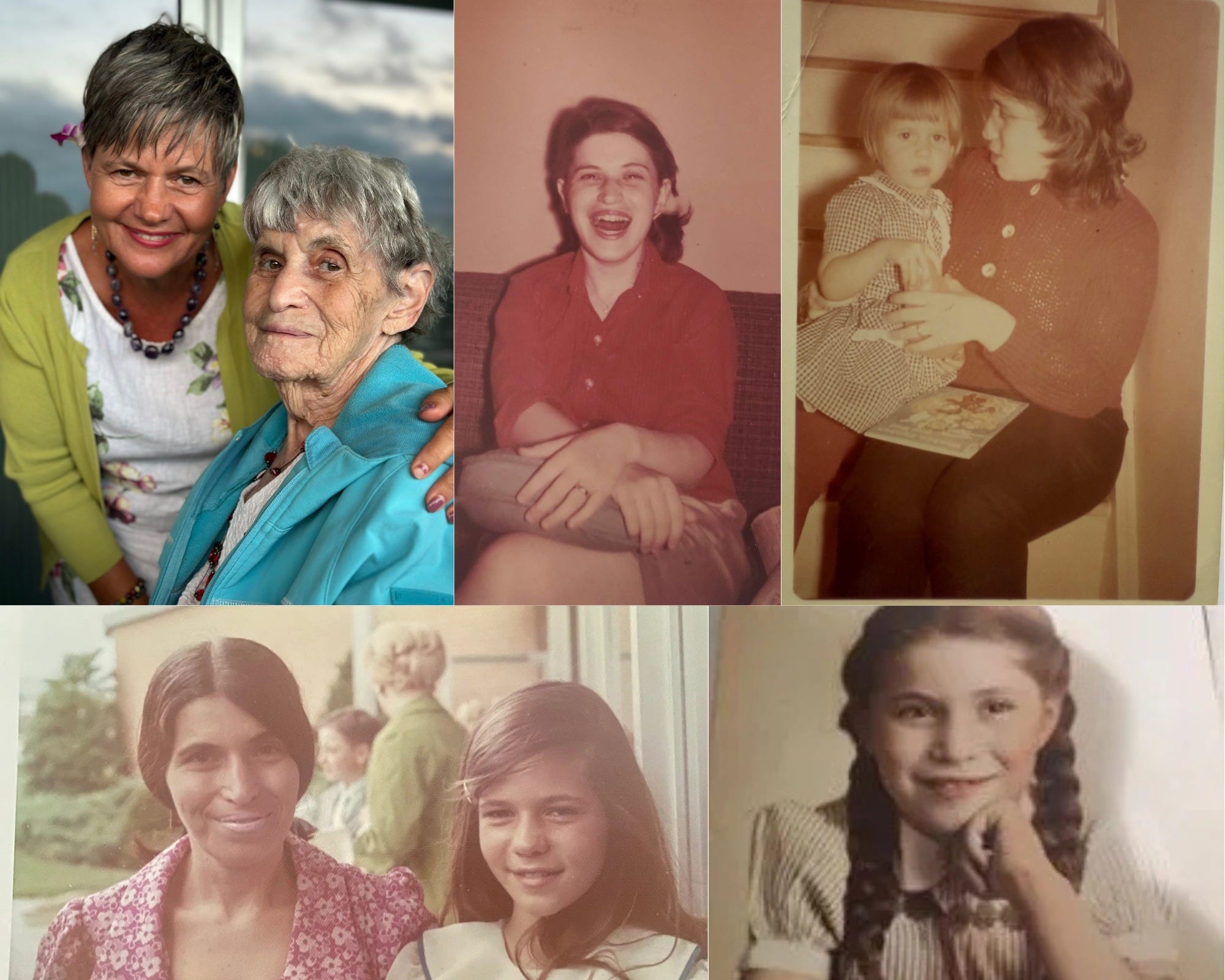
Picture Mom’s smile again. Don’t you see how delighted she would be to know that today you are living in Barcelona, that you bravely started a new chapter of life, after a divorce you initiated after 33 years of marriage. The decision to divorce and move out occurred just one month before Mom’s fall, rehab stay, and your life as her full-time caregiver began. You barely had a moment to take a breath from that huge life transition before the next major midlife transition came your way, the long goodbye of your cherished mamma. Dementia was a cruel interrupter of Mom’s beautiful life, but so it was for you, too, sweet pea.
Mom would have wanted you to reclaim your life just as you have – with courage, hope and joy. Live each day with extra radiance (your word for 2026); do it for her, too. She would want that. You know that. Deep down, I think you know that Mom always found you radiant, even as you thought you were letting her down. Like that time she clutched your arm as you were ending your visit with her at the facility. “Please,” she said. “Don’t leave me here. I want to go home.” When you asked, “Where is home, Mom?” she couldn’t answer. She dropped her hand and closed her eyes. You have never forgotten this moment. It is a struggle, even now, to forgive yourself for not taking her back home with you that day, only a few months before she died.
I urge you to forgive yourself. On the worst days of your ongoing grief (grief is never tidy, never linear), as you cry out, “I’m sorry, Mommy. I’m so sorry!”, can you hear her say, “There is nothing to be forgiven. You did your best, Amy. You always have.”
Here’s what I know now, a little older and wiser. Mom would want you to cherish the many – oh, so many! – happy memories of your 64-year story together. The story of Amy and Freda. We can always re-author the stories we tell ourselves. What a wonderful gift! The story of guilt and regret doesn’t serve you. Let’s tell a different story, one of love and self-compassion.
Here’s what I see as I look back with you on that April day in the sunshine. I see your mother’s smile as she gazes affectionately at you. I see your hand bringing the cookie to her lips, feeding her as tenderly as she once did you. I see love. I see trust. I see compassion.
Imagine yourself as a bird looking down at the scene. You know how Mom loved birds and trees and walks in the forest. Imagine it is a dove, the harbinger of peace. Let that little dove land on your shoulder, its wings fluttering like a soft breath on your skin. This is the forever peace that Mom inhabits. You get to live there, too, sweetie.
Remember the last words she said to you?
“I love you.”
That is all you need to know.
Love,
Amy
Link to articles by Amy:
‘I wish I could be like a bird in the sky’
For caregivers, a compendium of resources to help you take care of yourself, too
The Closing Rapid Fire Questions from Victoria:
1. Courage to me is befriending our fears and learning what they can teach us. The wise meditation teacher Dr. Lorin Roche says that fear is the most sincere form of prayer.
2. When I think of someone I admire, I think of my late, beloved mother Freda and particularly these three qualities that she inhabited every day of her life: kindness, generosity and humor.
3. I am a long-time collector of quotes, since my college days, with dedicated little journals for that purpose. One quote that gives me strength when my spirit is heavy is from Mark Nepo, the poet and spiritual guide, from The Book of Awakening, short passages of inspiration with which I begin each day. He writes: “Some days I wake with a cloud around my heart, and it dulls everything except the weight I carry deep inside. Yet just because I can’t make it to the light doesn’t mean the light has vanished. Faith can be defined as the effort to believe in light when we’re covered in clouds, and though it feels like the sun will never come again, the truth is it has never stopped burning its light. No cloud lasts forever.”
A prompt for comment discussion:
When was the last time you showed yourself compassion as a caregiver?
If your loved one has passed, are you showing yourself compassion for the journey as it unfolded (the way it was meant to), or is regret and guilt haunting you? Feel into all of it, without judgement.
Can you begin to re-author a story of guilt and regret by journaling on the happy and loving memories of times with your loved one?
Please ‘❤️’ LIKE the article & consider subscribing!
 | A guest post by
|
I’m so glad I got to know your Mother. One time I was visiting, we were all talking about our horiscopes. Out of the blue I blurted out to Freda, “I think you’re a Scorpion”.. if I’m thinking clearly, I remember her saying “I am!, how do you know?” (She reminded me of my Mom in many ways, and Bev was a Scorpion.) maybe it was their era that reminded me of each other.? I wish you had met my mom And that we all have tea together.🥰.. both wise, loved life, and mostly our biggest fan! Sorry my sharing might be a little long but while we’re on the subject, I’d love to share a story about when my mother passed. Bev was in the nursing home for a year and a half during Covid. So we could only visit her thru the window.😥.. finally, they let us come in to visit and Mom had a butterfly card she wanted hung up in her room so she could see it. By now she was bed ridden with advanced Parkinson’s. 8 weeks later she died and I got there 2 hours after she passed. Sobbing when I left, I was glad to have said goodbye and felt her sunny spirit in the room. The next day, sitting outside with my coffee, a yellow swallowtail butterfly slowly fluttered from the garden OVER TO ME, exactly like the one on the card she had me hang up. IT WAS MOM, saying it’s ok, I’m really good and free! 😭 thank you Mom!😭😇
What a compassionate letter you wrote to yourself, with the perspective of someone with unconditional love and infinite generosity of spirit. It feels as if your mother was talking with you. The way you described those gripping moments of the last stage of your mom's life squashed my heart. I'm so very glad for you, my dear friend, that you were finally able to express forgiveness and compassion to the part of you that experienced guilt about not having done enough for Freda. This new perspective is transformative. I hope you keep this vision with you and live in lightness.
P.S. I'm with you regarding what courage means!