
How can we navigate through misperceptions and misconceptions as caregivers?
5 articles sharing personal reflections and evidence-based insights from experts.

Hello! If you’re new to Carer Mentor, welcome! Thank you for being here! You can read why I’m publishing Carer Mentor here: Who Started Carer Mentor and Why?
The Carer Mentor website is a hub of tools, resources & insights, as well as a community support network. A portal of hope ❤️ Start exploring here.
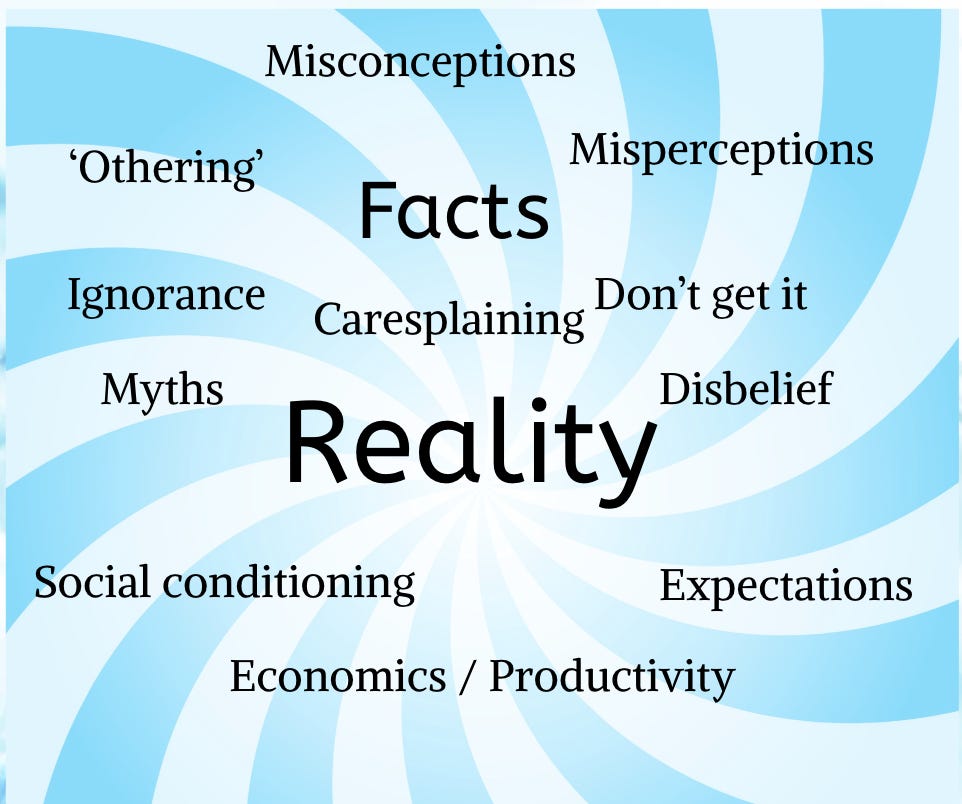
A carer’s reality can be swirled with many opinions, and it’s easy to internalise some of them, along with expectations or narratives. There are misperceptions we repeatedly face as carers.
So, I’m re-sharing a series of articles that offer this carer’s reflections and empathy for anyone feeling misunderstood or second-guessing themselves.
It’s a go-to reference for when you’re feeling ‘swirled’ or discombobulated. You’re not alone in what you’re feeling. Other carers, like myself, get it.
Article 1: What are our socially conditioned assumptions about caregiving, caregivers and respite? What can we do to support one another in our communities?” Read this article “Caregiving Misperceptions and Realities.
Article 2: “How Do We Disrupt Internalised Misperceptions About Caregiving, especially during the summer. The reframe. Creating space, not frustrations, and thriving in the small moments.” Can we compassionately review how we show up for ourselves and others this summer?
No one tells you that it’s the unavoidable, pain-joy, mess that IS life. Instead, we’re told we need to BE HAPPY, (cue songs and clichés). What happens when we try to make ‘Happiness’ a goal in life?
Article 3: ‘Why does pursuing happiness make us unhappy?’ Appreciating the messiness of now, reflecting on joy. Research conducted by Dr Iris Mauss, a psychologist at the University of California Berkeley, found that people who were very intent on being happy paradoxically had lower levels of well-being, higher levels of depressive symptoms, and overall, lesser happiness.
Article 4: ‘Misconceptions of Emotions. The Myths and Biases.’ Decoding Emotions: insights and resources. We judge our emotions. We’re conditioned by society and by each other. We apologise for our pain and tell ourselves we should feel grateful. Or wish emotions away. I wanted to know ‘why we do this to ourselves’, so I investigated the science, researchers’ insights, and their implications.
The things that make life rich, full and meaningful give you plenty of painful emotions as well as some very pleasant ones. - Dr Russ Harris
Article 5: ‘Misconceptions of Emotions: The Happiness Trap and a Paradox. Decoding emotions. Insights and resources.
Popular ideas about happiness will make you miserable if you actually hold on to them too tightly believe them too much or let them dictate how you live your life and there are three big happiness myths in particular that create this happiness trap - Russ Harris
“As a caregiver, the most essential gift has been to live in the liminal moments of paradox. Be human, real and imperfect. There are no perfect moments; there is no point in wasting the messy mix for the never-real.
I treasure the small moments, the silly moments of giggles and the small things so much more now. “ - By Victoria
I hope these articles and anecdotes resonate with your experience or offer fresh ideas for reflection. It’s not easy to short-circuit thoughts when they’re swirling. You’re not alone.
Share your thoughts here or in the July 2026 monthly discussion with our Carer Mentor Community Network: Eldercare/Caring for Parents. This question distracted and swirled me: “Doesn’t caregiving get easier over time?”
If you’d like to sponsor my work, please consider upgrading your subscription to a monthly or annual subscription. Please share the website so that others can benefit from its resources. Thank you!
You can read why I’m publishing Carer Mentor here: Who Started Carer Mentor and Why?
Carer Mentor amplifies the voices of Carers/Caregivers to see the person beyond the caregiving and to learn about diverse caregiving experiences. Topics include bereavement & grief, chronic health conditions, like cancer, autoimmune disease, heart failure, and dementia.
I connect people, lead collaborations, and curate anthologies to build a community support network that raises awareness about caregiving, carers, and the need for collective action and change. This is a space where carers can receive heartfelt empathy and inspiration from others who ‘get it.’
The Carer Mentor community network focuses on carers/caregivers but embraces everyone who is giving or receiving care for a chronic illness, disability, or health condition.
Start by reading this Quick-Guide to the website and introducing yourself