
Carer Mentor's 6th Birthday Newsletter.
April-May Roundup. Advocating for Bowel Cancer and Hospice Care UK.
Hello! If you’re new to Carer Mentor, welcome! Thank you for being here! You can read why I’m publishing Carer Mentor here: Who Started Carer Mentor and Why?
The Carer Mentor website is a hub of tools, resources & insights, as well as a community support network. A portal of hope ❤️ Start exploring here.
Dear Friends, it’s hard to believe that we’re already in May!
At the end of this week, Carer Mentor: Empathy and Inspiration turns 6 years old. I launched the website on my Dad’s birthday in 2020, the first without him. When I joined this platform, Substack, in October 2023, I felt that I could finally build the community network I’d envisaged with this fifth evolution of Carer Mentor.
I’m continuing to build Carer Mentor through collaborations, anthologies, and articles while caring for my mother. It feels a little weird looking back at previous editions and versions of the website. Figuring out how to build pages was a pain. I’m both relieved and appreciative of this platform’s functionality. It means I can focus on providing content, connecting with you, and building our community space. Of course, it’s also personally rewarding as my passion project and an easy way for me to feel less alone, while caregiving, too!
Thank you for being part of the Carer Mentor Community!
There’s been an annual spring clean of the website and a new collaboration initiative. In April, I launched the “Carer Mentor Community Network”, comprised of monthly discussion groups for carers by carers. I invited several caregiver friends to join me in answering any reader questions and sharing our thoughts.
The first Friday of each month, “Caregivers who are parents” meet, led by a team of 12 caregivers who share how they’re caring for a child with special needs, a disability, a rare disease, autism, cancer or another health condition. The April 3rd discussion was both revealing and deeply moving, thanks to the team members' vulnerable honesty. The next discussion was on May 1st, ‘Holding Both: When More Than One Truth Lives in the Same Body’. It was hosted by Maria Messer through her publication Holding Both. I hope you’ll read Maria’s article, which resonated deeply.
The second Friday of each month, “Eldercare/Caring for parents” will hold a similar discussion. The first will be this Friday, May 8th. Feel free to ask the team of 14 caregivers any question you wish, or reply to my discussion prompt. I’m intrigued to see your responses! Come join in if you can. Once the article is published, it’ll remain open, and we’ll reply. No pressure.
Both of these group discussion threads, like the ‘spring cleaning’ of the website, return to an initial premise for Carer Mentor: Care for the Carer. Often, the focus is on how to do the caregiving first and the caregiver second, because, of course, we’re all concerned about the medical needs, comfort, and care of our loved one. The ethos of my Carer Mentor work is to prioritise the carer, and then the caregiving. Hence, the revised format and structure of the desktop website:
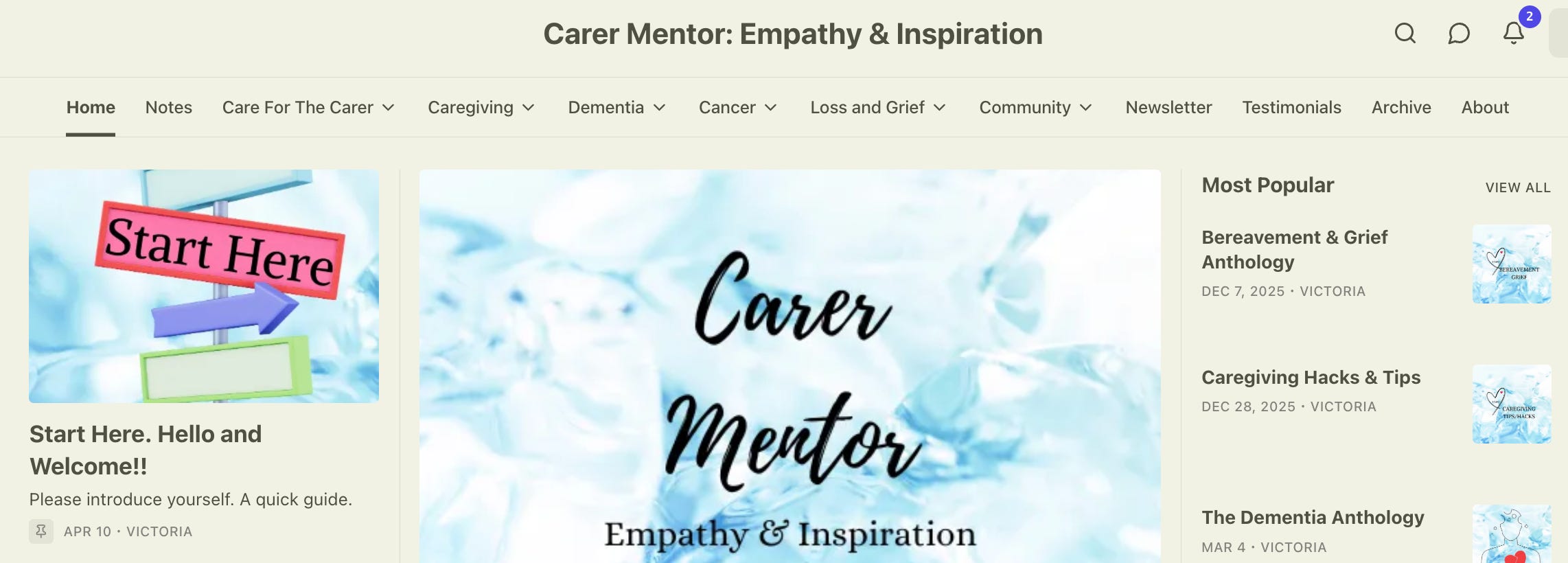
There are several articles and themes that I’ve organised into a toolbox for Carers. Have a look around the “Care for the Carer: A toolbox of learnings”.
There’s also a new anthology, “Eldercare/Caring For Parents”, to tie in with the 6th year birthday.
Yes, it’s been a very busy month, including an intense week where the D-Dimer Test helped us avoid an emergency hospitalisation. Read more about the D-Dimer Test?
It’s no wonder that I was scrolling to distract my brain a little. I wasn’t looking for hopeful inspiration, but it found me. So, I’m passing it along to you. As the TED organisation says, these are “Ideas worth spreading”. ….And perhaps I like to ‘Pay it forward.’ The #13 This Caregiver’s April Watchlist: “Discovering hope within these gems” shared the work of some activists who inspire, build community, and whose generosity is infectious. I loved the talks about infectious generosity and another about acts of kindness becoming a global phenomenon.
AND of course, I can’t leave out the heartfelt letters of compassion that each of these authors shared with their younger selves April “Letters From A Caregiver” Thank you, ladies!
“My caregiving journey is a family healing journey” By Viva Mogi, MPA
“Nothing and Everything Will Prepare You for This Moment” By Brittany Carroll
“But You Will: A Letter to My Younger (Suddenly) Caregiver Self.” By Tina Matras.
Two UK Awareness campaigns
Hospice care and Cancer awareness are important advocacy topics for me. Please take a few moments to read and share this information with friends and family. If you can, please support your local hospice. Thank you.
May 4 - 10 is “Dying Matters” Awareness Week. This year’s theme is ‘Let’s talk about Death and Dying’. In this discussion, we must discuss Hospice Care and care support in general. Contrary to what many people think, hospice care is 60% funded by charity. Already, hospices can’t pay staff, and beds are left empty
Bowel Cancer Awareness Month. (April) It’s a topic that I’m personally invested in, to encourage more people to get tested early. The passing of my close friend and my own scare last year underscores its importance.
Read more below.
If you’d like to support my work, consider using this 60% discount on a subscription forever. Carer Mentor content is an effortful gift that I’m passionate about giving to you freely.
Please click the ‘❤️’ to LIKE this article
Hospice UK’s Dying Matters Awareness Week 2026 is 4-10 May. This year’s theme is ‘Let’s talk about Death and Dying’.
“27% of people find it hard to talk about death with family or friends, and 30% bottle their feelings up. If we don’t talk about death and dying and bereavement, it can be harder to cope when we experience them. Polling commissioned by Celebration Day in 2025. 1
Talking about dying is particularly important right now. Hospices in England provide care for 270,000 people each year – sometimes in inpatient units, but more often, in people’s homes. The holistic care they provide includes highly specialist palliative and end of life care. Hospices also support tens of thousands of families and loved ones each year, including with bereavement support.
The majority of this care is funded by charity – marathon runs, gifts in wills, and charity shops. In fact, in England, on average, the NHS only funds around 40% of the care that a hospice provides.
The Problem: Marie Curie, the leading end-of-life charity in the UK, revealed these disturbing statistics from its recent research2
“Every three minutes, someone dies without proper support – nearly 200,000 people each year. And as the population grows older, the need for palliative care is rising fast. By 2050, that number could exceed a quarter of a million. It is a crisis hiding in plain sight.” TCS London Marathon: Marie Curie’s “Daffodil Runner” highlights the scale of the end-of-life care crisis
The research funded by Marie Curie goes on to say that almost 1 in 3 people don’t get the palliative and end-of-life care and support they need, with gaps even wider in disadvantaged communities. (How our research exposed the UK’s unmet need for palliative care, 16th February, 2026)
Nearly six in ten hospices have made or are considering cuts to frontline services this year. This means more pressure on an already creaking NHS, it means people dying in corridors, people dying without pain relief or privacy.
This cannot continue. Hospices want to be there for everyone who needs their care and support.
Charlie King, Director of External Affairs at Hospice UK, as part of their said, “We’re calling on the Government to act now by implementing Hospice UK’s four-point plan for fair funding, including fully funding the specialist palliative care we provide. A commitment of £112.5 million in additional recurring revenue funding would be a vital first step, preventing further devastating cuts and enabling hospices to continue delivering the care that patients and families rely on.”
Watch the video and read more via this link
April was Bowel Cancer Awareness Month in the UK.
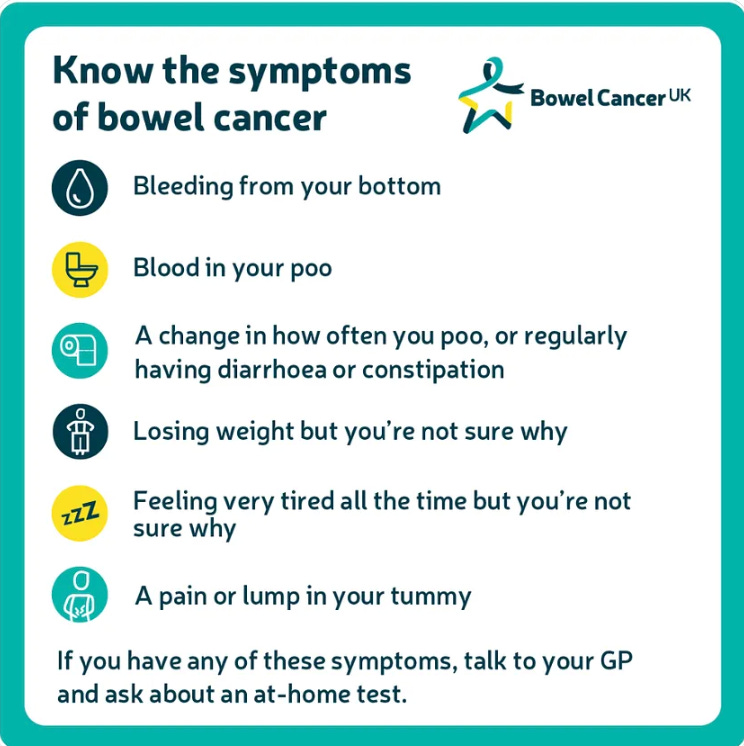
Key messages I shared to show how easy and painless it is to get checked.
Awareness: Know the symptoms of bowel cancer. Don’t doubt yourself. Don’t let poo be a taboo. Check your parents, too. Consult your GP/PCP.
There are bowel cancer screening programs, but don’t wait to get called to get checked if you have nagging symptoms. Track symptoms, report them to your doctor. We need to advocate for ourselves.
The Faecal Immunochemical Test (FIT) test is usually the first step. It’s a home-based screening kit that detects hidden blood in stool, which can indicate early bowel cancer or polyps. I received it by mail, followed the instructions and sent the test kit back. Easy, quick and simple. If positive, you’ll need to inform your GP for the next steps. Find more information at Bowel Cancer UK or Colorectal Cancer Alliance US
Awareness to Action: If in doubt, get tested. Don’t deprioritise your needs. You deserve to be sure of your health.
Why I decided to get tested in 2025: I had nebulous, on/off abdominal pains for a couple of months. I had no idea if these were ‘usual perimenopausal’ symptoms or something else. A very close family friend was diagnosed with bowel cancer in mid-2024. She passed New Year’s Eve. She was one of my favourite people. Her passing underscored my own worries. Worries were compounded by my family’s medical history of cancer: colon, bowel, endometrial, ovarian, bladder, lung.
Even when time is limited & it’s hard to plan, get tested. Research shows that more than nine in 10 people survive bowel cancer when it’s diagnosed at the earliest stage.
Learn from other people’s experiences: resources, recommendations and articles.
A colonoscopy is a no-brainer, simple check. I wrote this resource article for anyone new to having a colonoscopy.
Read more about getting tested and the experiences of six people in this article I wrote last year: Bowel Cancer Anthology
Please subscribe and ‘❤️’ LIKE this article to guide others to these resources.
If you’d like to support my work, you can use this 60% discount on a subscription forever.
“Celebration Day is a non-profit initiative built on a simple idea: to pause on the last Monday in May to remember and mark the memory of the people who made us who we are today.
They may be loved ones we have lost or figures in history, but they are the people who have inspired us and helped shape our lives, in many ways, they are our everyday heroes.
It is not commercial, political or a fundraiser; it is a day that belongs to us all.
#MarkTheirMemory for Celebration Day 2026.” Read more here
Wow, 6 years, and what a wonderful ever growing resource you've built and for being the most welcoming and supportive person on substack that I've met, thank you and to many more years of this fantastic newsletter
Congratulations 🎈 on 6 years! That’s incredible staying power! I know, from the comments I read, that you’re helping many. I don’t know how you do it all. It’s amazing!! 😻👏💛